Basic Cleaning Principles for Sensitive Optical Materials and Surfaces
Basic operational guidance for manufacturing and maintenance environments
Important note: Optical materials, coating structures, and assembly configurations differ in their tolerance to cleaning agents and contact cleaning. The following information provides general principles only. The specific cleaning method must be determined according to the material properties, coating requirements, and a validated production process.
Crystals such as calcite, BBO, and calcium fluoride, as well as certain fluoride optical materials, polymer optics, and unprotected soft‑metal coatings, may be sensitive to particles, contact pressure, or chemical media during cleaning. These materials should not be treated as a single category with identical hardness and toughness. The material, surface structure, and assembly condition must be assessed individually before cleaning.
1 Basic Principles
- Remove loose particles first, and then determine whether wiping is necessary. Do not touch or rub the surface repeatedly while particles remain.
- Confirm the compatibility of every cleaning medium. No single cleaning agent or method is suitable for all optical components.
- Select the wiping path according to the component geometry, surface type, and validated process. A one‑direction drag wipe may be suitable for some flat optics; other geometries require their own approved procedures.
- Minimize unnecessary contact and repeated cleaning. Do not perform additional wiping merely to make the surface appear cleaner.
2 Preconditions and Safety Requirements
- Wear powder‑free gloves or finger cots and handle the component only by its edges or non‑optical surfaces.
- Use a new piece of optical‑grade lens tissue or a validated clean tool for each wiping pass to prevent cross‑contamination.
- Before cleaning an assembled component, confirm that the cleaning agent will not affect adhesives, edge coatings, markings, or mounts.
- Ethanol, isopropyl alcohol, acetone, and similar solvents are flammable. Provide adequate ventilation and keep them away from ignition sources.
- For high‑precision optics, high‑power laser optics, or specially coated components, follow the drawing, coating supplier instructions, and applicable internal inspection specifications.
3 Selection of Tools and Cleaning Media
| Tool or medium | Typical use | Requirements and limitations |
|---|---|---|
| Clean low‑pressure air or nitrogen | Removal of loose particles before contact cleaning | The gas must be clean, dry, oil‑free, and filtered. Do not use shop air containing oil or moisture. When using canned gas, prevent liquid propellant from reaching the surface. |
| Optical‑grade lens tissue or a validated lint‑free tool | Surfaces approved for contact cleaning | Use a fresh tool for each pass. Wet it sufficiently and wipe gently along the validated path. Never dry‑wipe. Ordinary eyeglass cloth is not a universal tool for precision optical surfaces. |
| Validated clean swab or dedicated tool | Grooves, small areas, or difficult‑to‑reach locations | Confirm the risks associated with fiber or particle shedding and contact pressure. No single swab type is suitable for every material. |
| High‑purity cleaning agent | Removal of a contaminant known to be soluble | Confirm compatibility with the substrate, coating, cemented interfaces, and assembly materials. Ethanol, isopropyl alcohol, acetone, and all other solvents require compatibility verification before use. |
| Unprotected soft‑metal coating | Unprotected gold, silver, or aluminum surfaces | Prefer non‑contact particle removal and follow the coating supplier’s instructions. Direct wiping is not recommended unless the process has been specifically validated. |
4 Basic Cleaning Procedure
- Non‑contact particle removal: Use clean, dry, oil‑free, filtered low‑pressure air or nitrogen to remove loose particles. Keep the nozzle at a safe distance to avoid impact damage or contamination by propellant.
- Confirm the cleaning method: Identify the substrate, coating, cemented interfaces, and assembly materials. Select a cleaning agent and tool that have passed compatibility verification. Acetone may damage plastic optics, some cemented interfaces, and assembly materials and must not be treated as a universal recommendation.
- Wipe gently according to the validated process: Use contact cleaning only when it is necessary and permitted. A one‑direction drag wipe may be suitable for some flat optics. For other components, determine the path according to the geometry, surface type, and approved procedure. Do not rub repeatedly while particles remain.
- Inspect and evaluate: Under suitable illumination and viewing angles, inspect for particles, scratches, liquid residue, or fibers. High‑precision and high‑power laser optics must also be evaluated according to the applicable inspection specification.
Basic Process Illustration
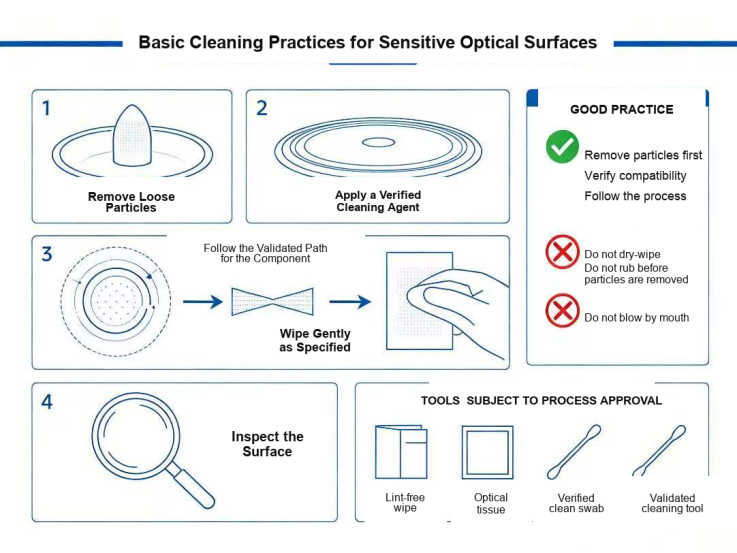
This illustration summarizes general principles. The actual method must follow the material, coating, and validated process requirements.
5 Common Errors and Risks
- Dry wiping: Residual particles may act as abrasives and scratch the surface.
- Repeated rubbing before particle removal: This may cause secondary scratching or drag contamination across the clear aperture.
- Blowing by mouth: This may introduce saliva, moisture, and additional particles.
- Using an unverified solvent: The substrate, coating, cemented interfaces, markings, or mount may be damaged.
- Directly wiping an unprotected soft‑metal coating: Any contact may produce fine scratches; non‑contact methods should be preferred.
6 Process Control in Manufacturing
In optical fabrication and post‑processing, cleaning is not a simple stand‑alone step. CX Photonics evaluates the material properties, coating structure, assembly condition, and subsequent inspection requirements before defining the cleaning medium, tool, contact pressure, and wiping path. Where necessary, compatibility testing is performed to reduce the risk of damage to the substrate, coating, and assembled structure.
Cooperation Inquiry