The Role of Sapphire Crystal Orientation in Optical Windows and Polarization Components
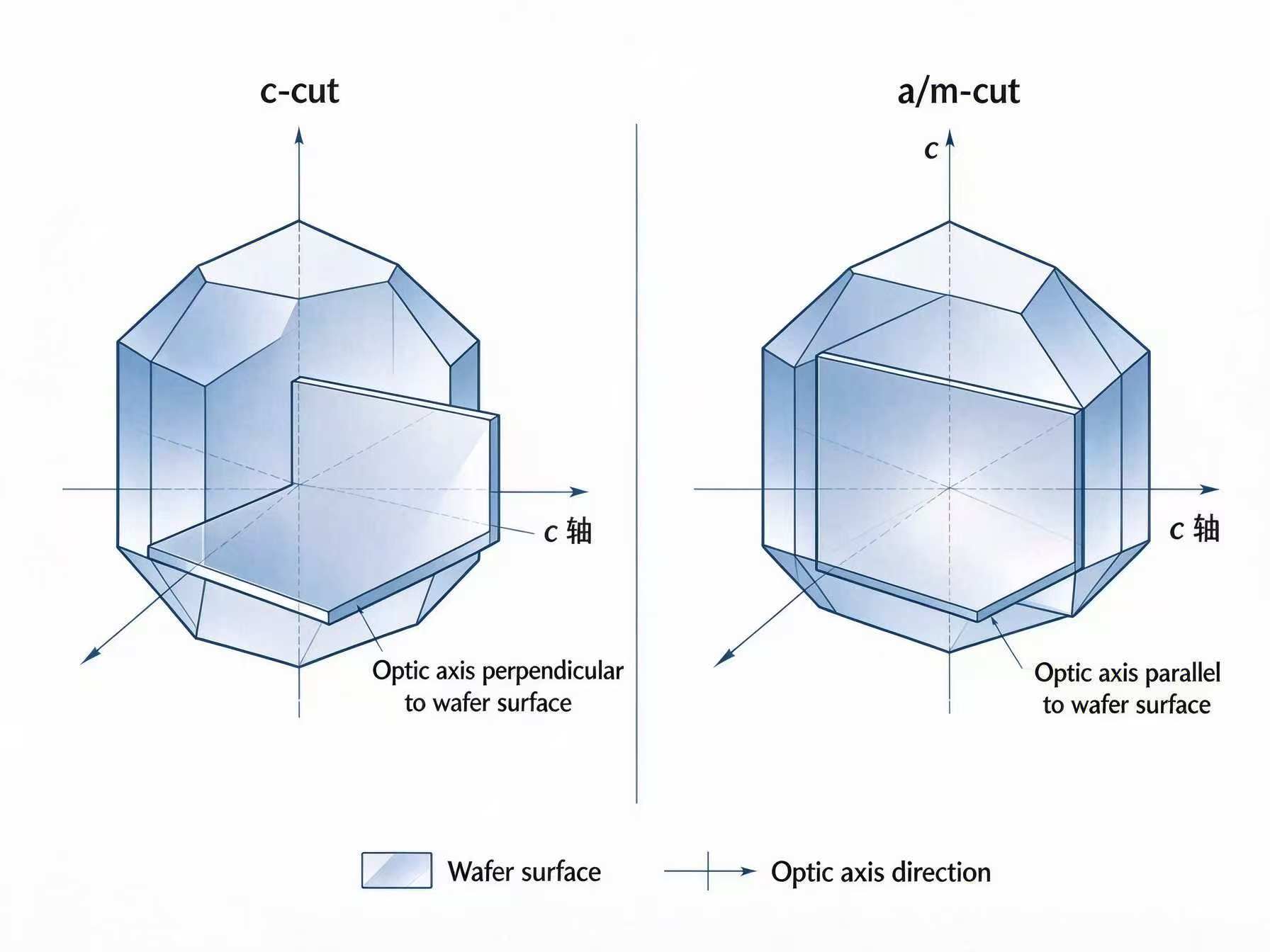
Sapphire optic axis (c‑axis; sapphire is a uniaxial crystal, and the optic axis is parallel to the unit‑cell c‑axis)
I. Basic Properties
Sapphire (Al₂O₃, α‑alumina) is a negative uniaxial crystal. Its optic axis coincides with the crystal c‑axis, and it exhibits birefringence between the ordinary (o) and extraordinary (e) rays.
Sapphire is mainly cut in two orientations:
- 1. c‑cut (basal‑plane cut): the wafer surface is perpendicular to the c‑axis (the optic axis is perpendicular to the window surface)
- 2. a‑cut / m‑cut: the wafer surface is parallel to the c‑axis (the optic axis is parallel to the window surface)
During process verification of sapphire components, CX Photonics has found that selecting the wrong cutting orientation directly causes a series of optical‑path problems, including birefringence and polarization distortion.
II. Sapphire Windows: Functions and Selection of the Two Orientations
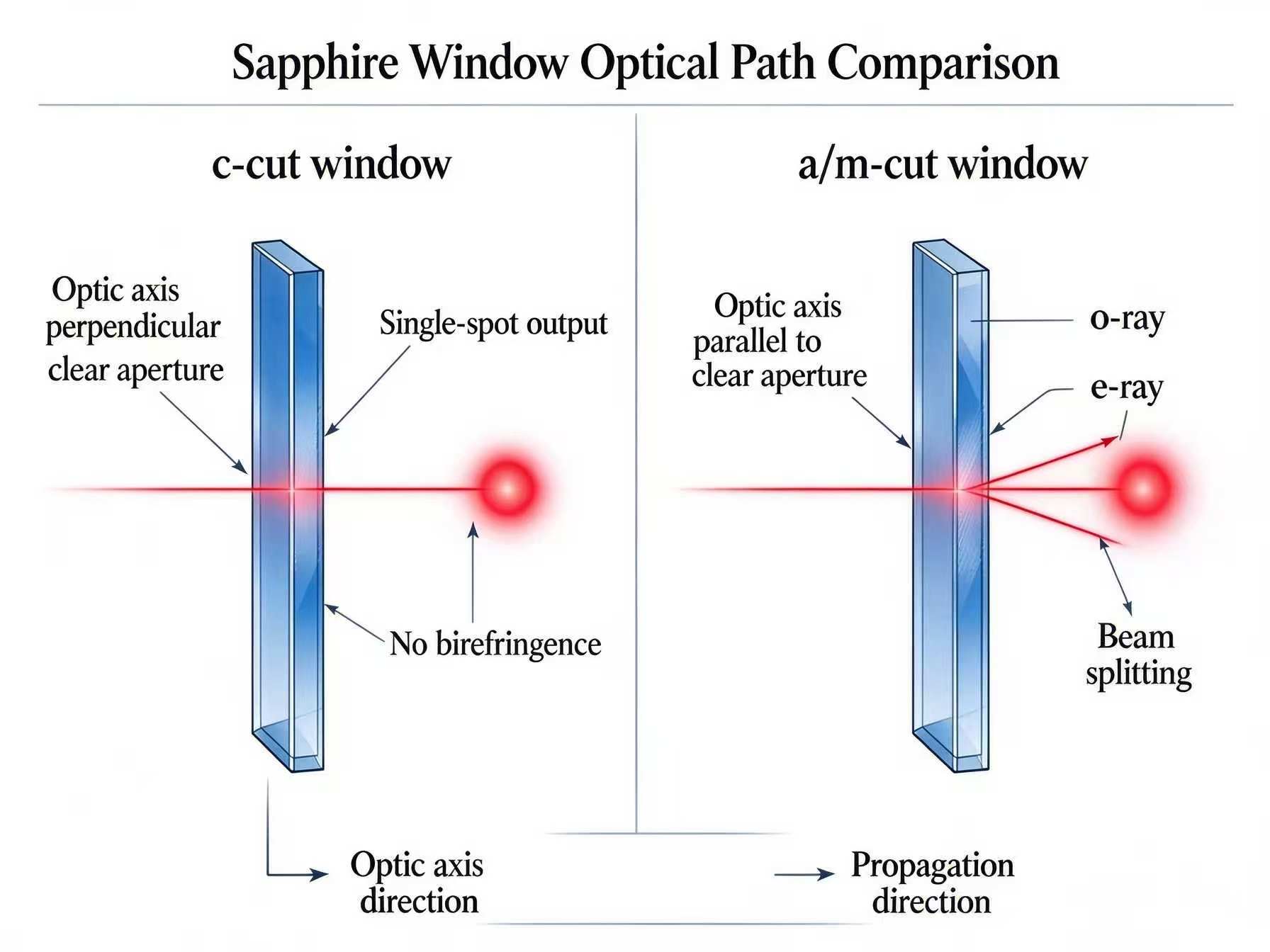
1. c‑cut window (the optic axis is perpendicular to the clear aperture, and the beam propagates along the optic axis)
- When light is normally incident on the window, its propagation direction is parallel to the optic axis:
- No birefringence: the refractive indices of the o‑ray and e‑ray are equal, and the light does not split into two spots;
- No phase retardation, so the polarization state of the incident light is not changed;
- No polarization‑dependent loss and no polarization aberration.
Applications: optical windows, laser‑cavity sealing windows, high‑temperature infrared windows, and high‑precision observation windows;
Advantages: does not disturb beam polarization or produce double images. c‑cut sapphire is the first choice for the vast majority of optical windows.
Additional note: in high‑precision optical systems, even when a c‑cut window is used, the crystal orientation tolerance must be controlled; orientation deviation can still introduce weak birefringence interference.
2. a/m‑cut window (the optic axis is parallel to the clear aperture, and the beam propagates perpendicular to the optic axis)
At normal incidence, the propagation direction is orthogonal to the optic axis, and birefringence is strongest:
- Incident natural light is separated into two orthogonally polarized rays, the o‑ray and e‑ray, producing a phase difference;
- After linearly polarized light passes through, its polarization state changes and a waveplate effect is produced. However, the phase retardation is uncontrollable, so it cannot be used directly as a standard waveplate.
Disadvantages: causes beam‑spot splitting and polarization distortion;
Special uses only: applications requiring simple phase retardation or low‑temperature polarization sensing. It is strictly prohibited for ordinary windows.
Core conclusion for windows: ordinary transmissive windows should always use c‑cut sapphire. Its absence of birefringence when light propagates along the optic axis eliminates polarization interference.
III. Role of Sapphire Orientation in Polarization Components
Sapphire itself has relatively low birefringence and is rarely used alone as a polarizing beam‑splitting prism. However, it is often used as a substrate in polarization optics, a supporting component for optical rotation, or a UV polarization‑compensation plate. Its orientation determines the polarization function:
1. For quarter‑wave and half‑wave phase retarders (waveplates) — an a/m‑cut is required
The optic axis is parallel to the wafer surface, and the beam passes through perpendicular to the optic axis. A fixed optical‑path difference between the o‑ray and e‑ray converts the polarization state:
- Half‑wave plate: rotates the polarization direction of linearly polarized light;
- Quarter‑wave plate: converts linear polarization ↔ circular polarization.
A c‑cut plate cannot be used as a waveplate because propagation along the optic axis produces no phase difference.
2. Windows in polarization systems / isolator substrates — use c‑cut sapphire
Protective windows before and after polarizers and polarizing beam splitters in an optical path must be c‑cut. This prevents the window's own birefringence from introducing an additional phase difference and prevents degradation of the polarization extinction ratio. When evaluating supporting components for polarized optical paths, CX Photonics focuses on checking the crystal orientation of sapphire windows to avoid such system risks.
3. UV depolarizers (polycrystalline / single‑crystal combinations)
Multiple sapphire elements with different a‑axis orientations are arranged with their optic axes perpendicular to one another. The opposite phase retardations produced by the orthogonal optic axes compensate for polarization‑dependent loss and achieve broadband depolarization. This solution is mainly used in experimental setups and is less commonly used in mass‑produced components.
4. High‑power polarized‑laser windows (femtosecond, UV)
Sapphire windows are commonly used for high‑power UV lasers. c‑cut sapphire has no birefringence and therefore does not produce local phase distortion from the optical‑path difference between the o‑ray and e‑ray, avoiding laser self‑focusing and component damage.
IV. Key Comparison Summary
| Component application | Preferred orientation | Core function |
| Standard optical window | c‑cut (optic axis perpendicular to the surface) | The beam propagates along the optic axis, with no birefringence and no disturbance to polarization |
| Waveplate and polarization‑compensation plate | a/m‑cut (optic axis parallel to the surface) | Uses birefringence to produce controllable phase retardation and control the polarization state |
| Protective window in a polarized optical path | c‑cut | Maintains the system extinction ratio without introducing additional polarization error |
| Supporting substrate for laser polarization beam‑splitting optics | c‑cut | Prevents beam‑spot splitting and polarization distortion |
V. Differences Between Sapphire Orientations
- The orientation of the sapphire c‑axis can be quickly determined using X‑ray diffraction (XRD), and c‑cut is the default orientation for window fabrication;
- If a‑cut sapphire is mistakenly used as a laser window, beam ghosting, polarization drift, and a lower extinction ratio will occur;
- Sapphire has much lower birefringence than YVO₄ and calcite. It is not suitable for polarizing beam‑splitting prisms and is used only for phase compensation and high‑transmission windows.
Optical‑component manufacturers in China, including CX Photonics, treat crystal orientation accuracy as a key quality‑control point in sapphire crystal processing.
Cooperation Inquiry